
A laboratory recently contacted us because their nightly database optimization had stopped working. SENAITE LIMS was running fine on the surface — users could log in, create samples, enter results. But under the hood, the database was growing unchecked because the scheduled pack operation was silently failing every night.
The cause: a single corrupted database record. One truncated object, likely produced months earlier when a server restart interrupted an active write operation. That one bad record blocked the entire garbage collection process, causing the pack to abort with an EOFError every time it ran.
The Problem With Reactive Maintenance
This is a typical scenario for SENAITE LIMS installations that run without active monitoring. Everything appears to work until it does not. By the time someone notices, the problem has compounded:
- The database had grown significantly beyond its packed size, consuming disk space and slowing down operations.
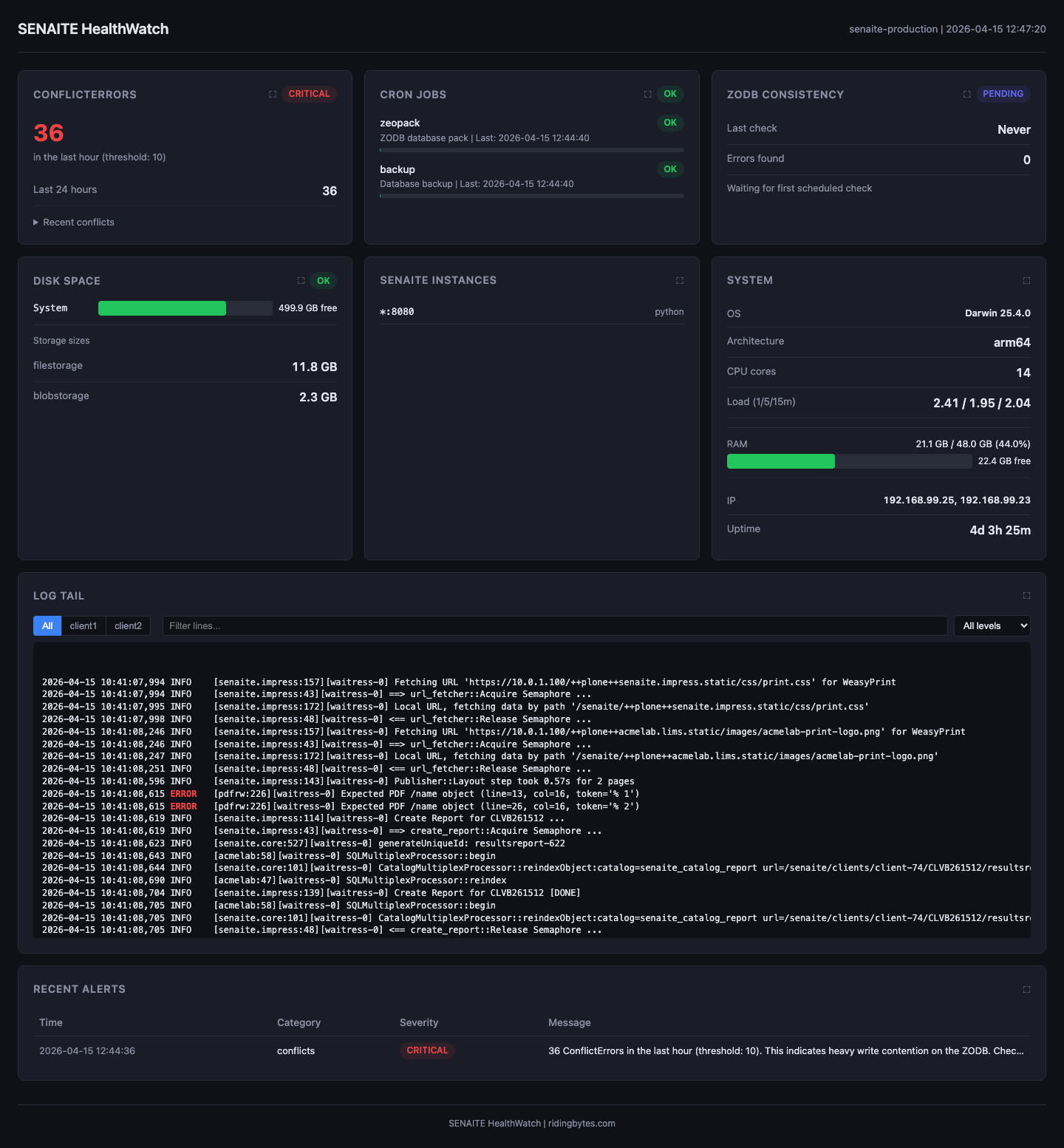
- Multiple ZEO clients were producing ConflictErrors during concurrent Excel imports, because the ZEO server lacked the application eggs needed for automatic conflict resolution.
- The ConflictError rate was high enough to risk further data corruption under specific timing conditions.
None of these issues produced visible errors for end users. They only surfaced when we investigated the failed pack operation.
What SENAITE LIMS Monitoring Catches
With continuous SENAITE LIMS monitoring in place, every one of these problems would have been detected early:
Database consistency. A weekly ZODB integrity scan would have flagged the truncated object within days of its creation, not months later when the pack failed.
ConflictError rates. Continuous log analysis detects write contention between ZEO clients. A spike in ConflictErrors during import hours is an early warning that the database configuration needs attention.
Cron job execution. A dead man’s switch for scheduled tasks (database pack, backups) alerts immediately when a job fails or does not run at all. No more silent failures accumulating for weeks.
Disk space trends. Monitoring free space over time reveals when an unpacked database is consuming storage faster than expected, giving time to act before the disk fills up.

The Fix Was Straightforward
Once identified, the actual repair took minutes. We replaced the truncated database record with a minimal placeholder object, fixed the ZEO server configuration to enable proper conflict resolution, and ran a successful database pack. The installation is back to a healthy state.
The point is not that the fix was complex. It was not. The point is that without monitoring, these issues sat undetected for months, compounding silently.

SENAITE Care
We built SENAITE Care to solve exactly this problem. It is a managed service for SENAITE LIMS installations that provides:
- Automated 24/7 monitoring via HealthWatch (our purpose-built monitoring service for SENAITE)
- Scheduled maintenance (database optimization, log analysis, OS security updates)
- Defined response times and support channels
- Optional managed hosting on dedicated servers in Germany
Three service tiers are available, starting at EUR 300/month for monitoring and quarterly maintenance. Details and plan comparison are on the SENAITE Care product page.
If you are running a SENAITE LIMS installation in production, proactive SENAITE LIMS monitoring is not optional — it is the difference between catching a corrupted record in a weekly scan and discovering it months later when your database maintenance breaks down.
Contact us to discuss which plan fits your installation.

Ramon
Related Posts
A laboratory recently contacted us because their nightly database optimization had stopped working. SENAITE LIMS was running fine on the surface — users could log in, create samples, enter results. But under the hood, the database was growing unchecked because the scheduled pack operation was silently failing every [...]
We built SENAITY because we kept watching labs verify results they should not have. After years of working with laboratories running SENAITE LIMS, the pattern was always the same: a single bad value slips through the verification step, gets published, and reaches a customer. The cost is never [...]
