
Service
SENAITE Qualification
We run an automated catalogue of test cases against a copy of your SENAITE LIMS and hand you a protocol that documents every test, its requirement, the expected and the actual result, ready for your review, your signature and your auditor.
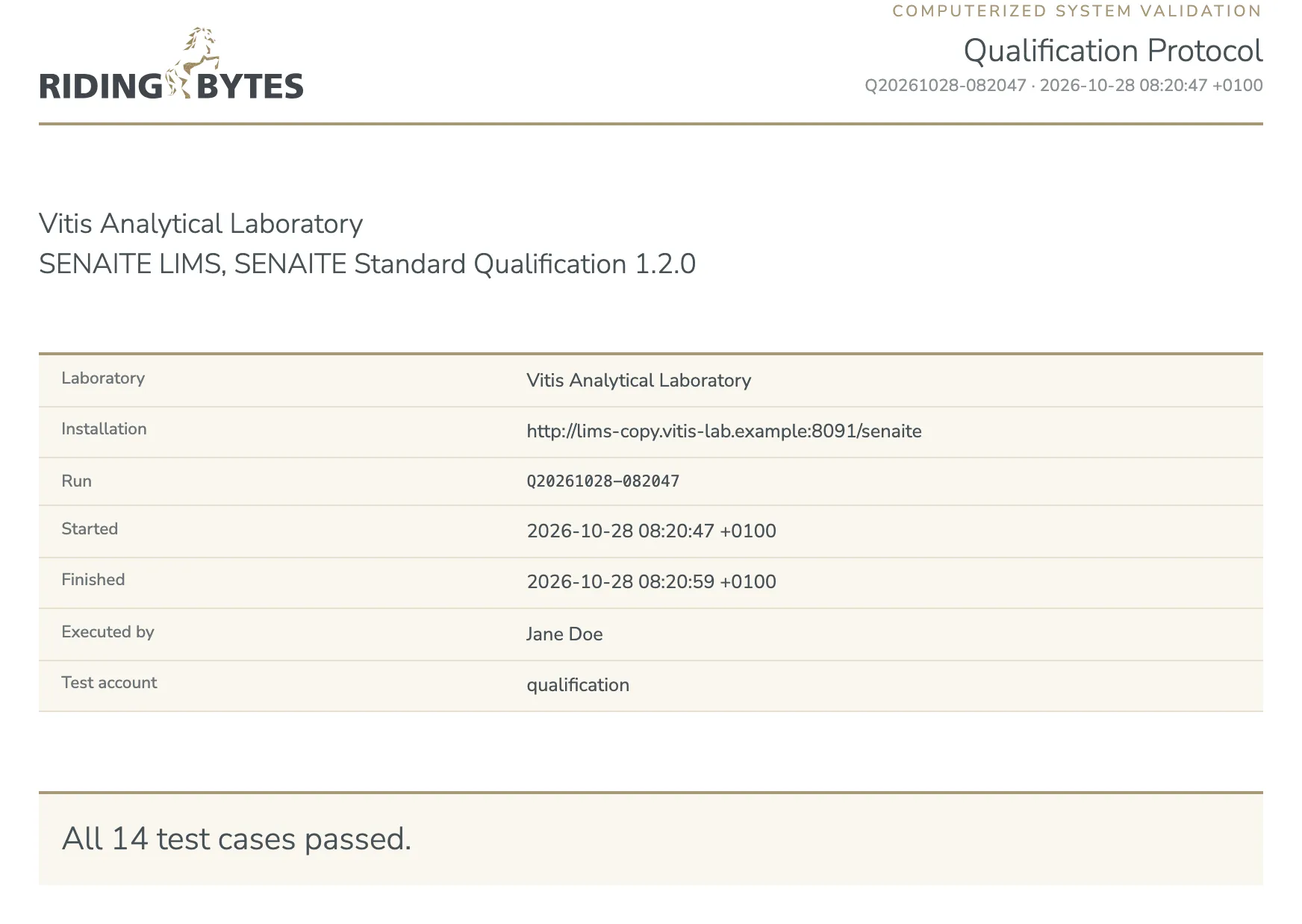
The evidence that a LIMS works as specified is usually produced by hand. Somebody clicks through a list of test cases, takes screenshots and types up a report. That takes weeks, it is repeated after every update, and it is done again when an auditor asks how a particular result came about.
SENAITE Qualification is for laboratories that use SENAITE LIMS and have to show that their software works as specified.
- ISO/IEC 17025 and ISO 15189, including clinical laboratories.
- GMP and clinical studies.
- After every update of SENAITE or of your configuration.
The qualification protocol as PDF, ready for your signature. It contains:
- Cover with laboratory, installation, run and result
- Scope and who is responsible for what
- Test environment with SENAITE versions and catalogue checksums
- Summary of all test cases with category, risk and result
- Traceability matrix from requirement to test case
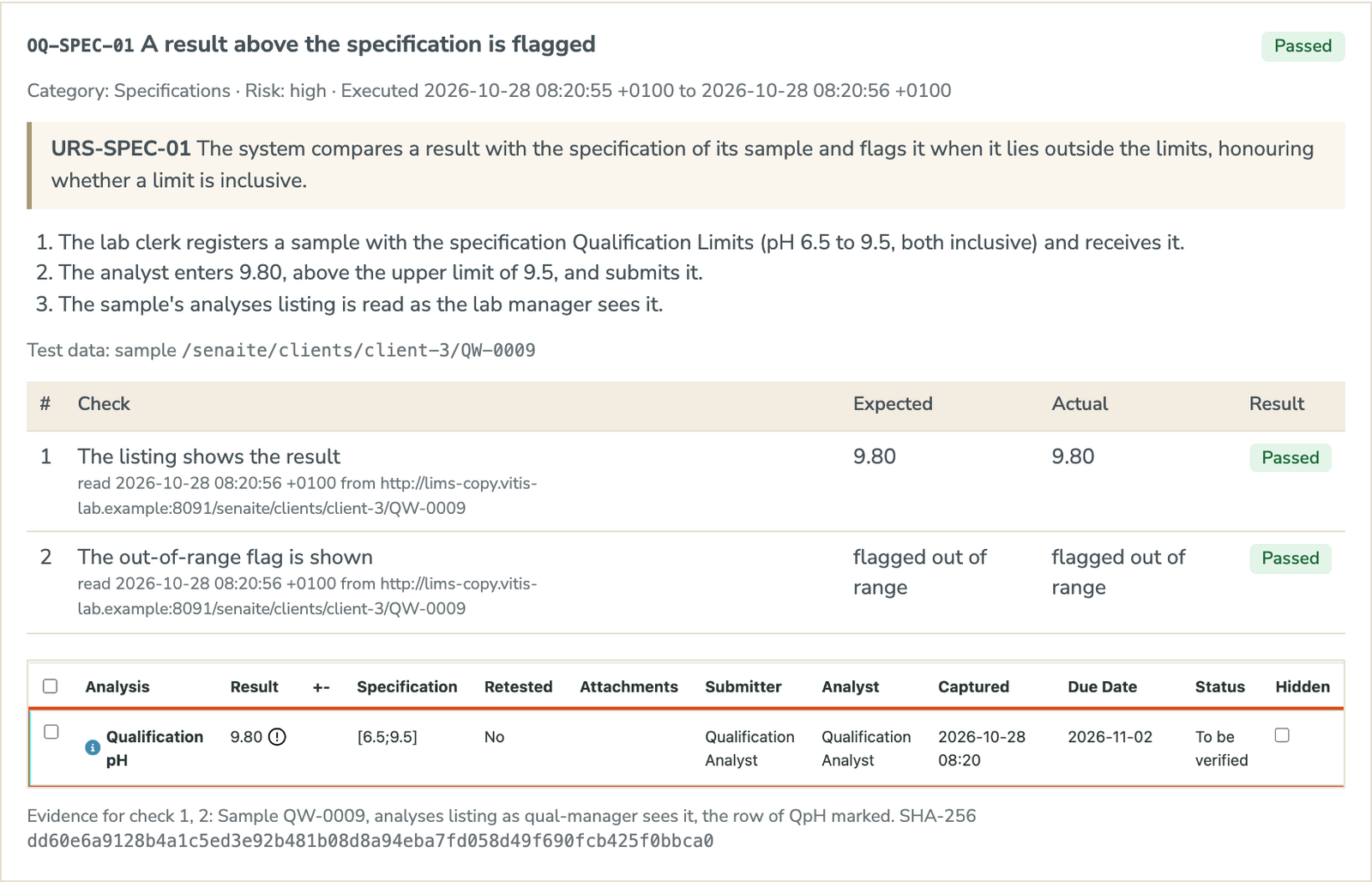
- Every check with expected and actual value, and screenshots as evidence
- Table of deviations for your assessment
- Approval block for your signature
With it you receive the run record the protocol is generated from, for your archive, and a review meeting in which we go through the protocol and the deviations with you.
Download the sample protocol (PDF) 19 pages, a fictitious laboratory, all 14 standard test cases.
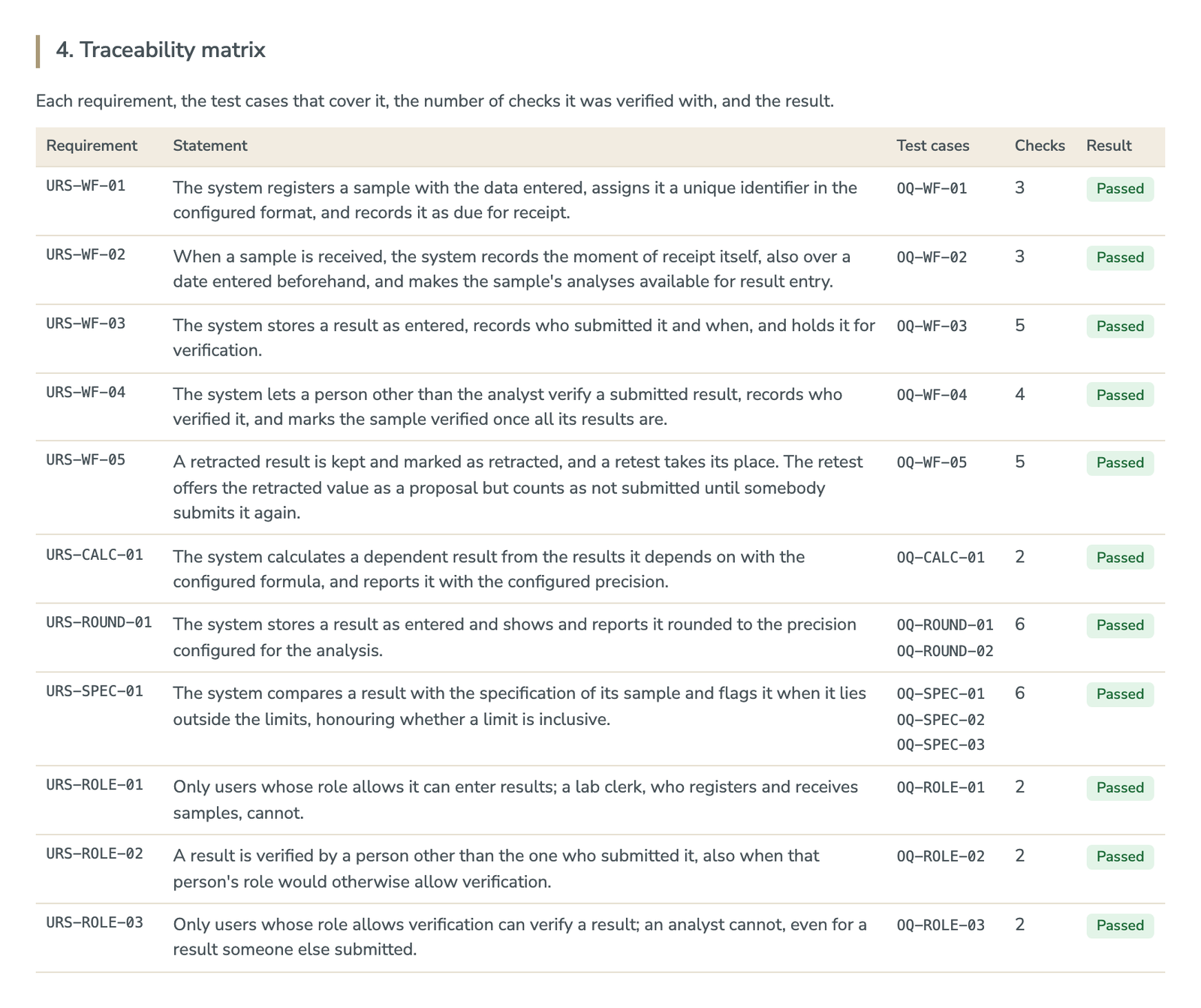
The standard catalogue covers what every laboratory relies on and every auditor asks about. It currently has 14 test cases in five groups. It brings its own configuration: your services, specifications and users are not changed.
- Workflow. Registration, receipt, submission, verification by a second person, retraction and retest.
- Calculations. A calculated result follows from the results it depends on.
- Rounding. Results are shown with the configured precision.
- Specifications. Results above, within and on a limit are flagged correctly.
- Roles. A clerk cannot enter results, nobody verifies their own result, an analyst cannot verify a colleague's result.
What your laboratory has configured itself needs test cases of its own: your calculations, your specifications, your sample ID format, your workflows. We write these cases from your requirements, each with its requirement ID, a risk rating and its checks. Where your configuration deliberately differs from the standard, your case replaces the standard case, and the protocol records why.
Not part of the standard catalogue yet: the PDF test report, instrument imports, sample labels, the audit trail and attachments. Where they matter for your qualification, we cover them with laboratory-specific test cases or document them as not tested.
| The auditor asks | Test cases |
|---|---|
| Does the system record who submitted a result, and when? | OQ-WF-03 |
| Is every result verified by a second person? | OQ-WF-04 OQ-ROLE-02 |
| What happens to a result that is retracted? | OQ-WF-05 |
| How do you know a calculated result is correct? | OQ-CALC-01 |
| Is the reported value rounded as configured? | OQ-ROUND-01 OQ-ROUND-02 |
| Is a result outside the specification flagged? | OQ-SPEC-01 OQ-SPEC-02 OQ-SPEC-03 |
| Who can enter results, and who can verify them? | OQ-ROLE-01 OQ-ROLE-03 |
OQ-WF-03 and the other codes are the IDs of test cases in the protocol. The terms are explained below.
- URS. User requirement specification: what your laboratory requires of the system, in your own words. The requirement IDs in the protocol (URS-WF-01) refer to it.
- IQ. Installation qualification: evidence that the system is installed as documented.
- OQ. Operational qualification: evidence that the system works as specified. The test case IDs (OQ-WF-03) belong to it.
- PQ. Performance qualification: evidence that the system does what your laboratory needs, with your configuration, in daily work.
- GAMP 5. A risk-based guide by ISPE for computerised systems in regulated environments, widely used as a frame of reference by laboratories and auditors.
- Traceability matrix. A table that links every requirement to the test cases that check it.
The service produces the evidence for operational qualification (OQ: does the system work as specified) and for the parts of performance qualification (PQ) your laboratory configures itself, in the terms of GAMP 5. Together with the admin guide of a certified SENAITE Enterprise VM, which covers installation qualification (IQ), you have the evidence for IQ and OQ.
It does not:
- write your user requirements, risk assessment or validation plan,
- decide whether the system is fit for your intended use,
- state that your laboratory meets a standard.
These stay with your laboratory, and the protocol says so in its first section. Your laboratory provides or approves the requirements, reviews the protocol, assesses each deviation, and approves or rejects. We prepare the copy, write the laboratory catalogue, run the catalogues, hand over protocol and run record, and go through the result with you. On request we support your requirements and risk assessment as consulting.
- 1Kick-off
Scope, your requirements, and which parts of your configuration go into the laboratory catalogue.
- 2Copy
You provide a copy of your site, or we create it from a recent backup. Tests never run against production: a run creates samples and users and moves them through the workflow.
- 3Laboratory catalogue
We write your test cases and agree them with you.
- 4Run
Standard and laboratory catalogue run on the copy.
- 5Review
We go through the protocol and the deviations with you. You assess, approve and sign.
Prerequisite: SENAITE 2.7 or newer on the copy, with matching versions of your add-ons. Older installations are updated first, which we offer separately.
For the first laboratories we run SENAITE Qualification as a pilot at preferential terms: the standard catalogue, a laboratory catalogue with your first test cases, the protocol, and the review meeting.
In return we ask for your feedback on the protocol, permission to include your test cases in anonymised form in our standard catalogue, and permission to name your laboratory as a reference after completion.
Related
Pair this with

Join the pilot
Tell us about your laboratory, your accreditation and your SENAITE version. We reply with the scope of a pilot and the next steps.